About Sacred Sites
Learn about sacred sites as ancient places of power, ceremony and connection with the Earth. This page explores stone circles, standing stones, ley lines, the sacred landscapes of the British Isles and beyond, and the living energy held within these places.
What Are Sacred Sites?
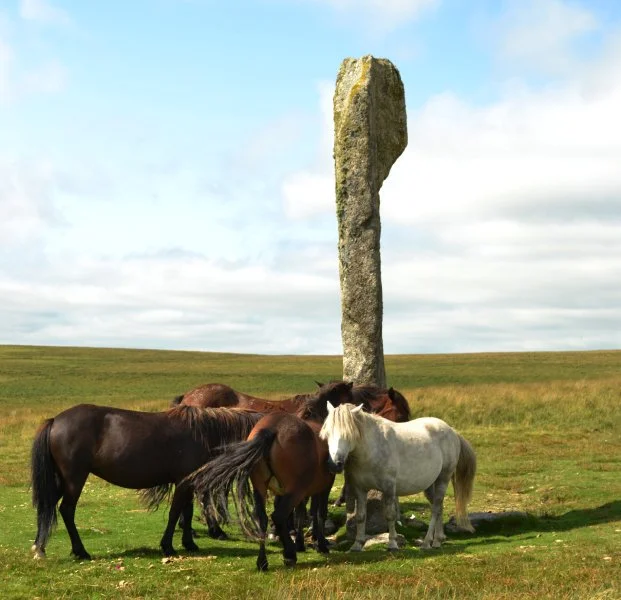
Drizzlecombe Monolith, Dartmoor, South Devon
Sacred sites are places where the energetic current of the earth rises to the surface. They are points of power on the vast network of energy lines that run beneath and across the landscape, sometimes called ley lines, and they have been recognised and marked by human beings for thousands of years. Long before recorded history, our ancestors understood that certain places in the landscape held a particular charge, and a quality of energy that could support healing, ceremony, vision, and communion with the wider web of life.
These places are not confined to one culture or one corner of the world. They are found on every continent and in every tradition. The well-known sites of Stonehenge and Avebury in the British Isles, the stone alignments at Carnac in Brittany, the great pyramid complex at Giza and Machu Picchu high in the Peruvian Andes all point to the same understanding: that the earth itself is alive, and that certain points on its surface offer a more direct doorway into that living energy than others. Across vastly different cultures and centuries, human beings have been drawn to these same places, built on them, and returned to them again and again. They leave us clues about the sophistication and spiritual understanding of the civilisations that came before us.
Sacred Sites in the British Isles and Beyond
Across the British Isles, sacred sites are woven into the landscape in extraordinary numbers. Stone circles, standing stones, burial mounds, stone rows and ancient enclosures dot the hills, moorlands and valleys of these islands, many of them thousands of years old. They are found from the tip of Cornwall to the far north of Scotland, across Ireland and Wales, and each one placed with intention and precision by people who understood the land beneath their feet in ways that we are still exploring and coming to understand.
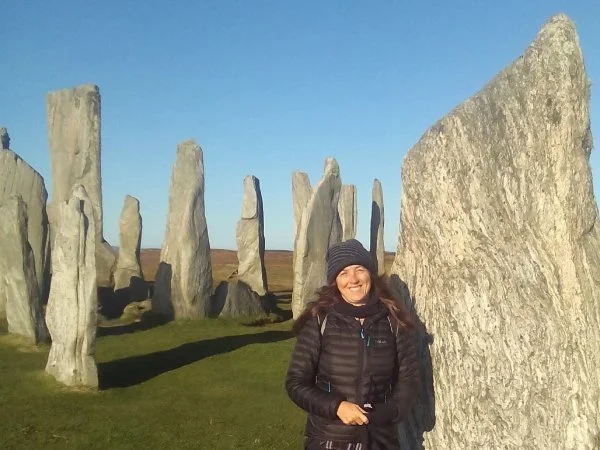
Callanesh, Scotland with Liz Meadows
Dartmoor holds one of the highest concentrations of prehistoric sacred sites anywhere in Britain. This is partly due to the nature of the terrain. The high, open moorland has never been heavily built upon or intensively farmed, leaving many sites remarkably intact. But it is also a reflection of the people who lived here. The Iron Age Celtic tribes of Devon and Cornwall, known as the Dumnonii, inhabited this landscape for far longer than many other tribal peoples in England, and crucially, Roman influence never fully reached this far west. Where Roman occupation reshaped and often erased the sacred landscapes of other regions, Dartmoor was largely spared. What remains here is therefore one of the most complete and undisturbed prehistoric sacred landscapes in Europe.
The Sacred Sites of Dartmoor
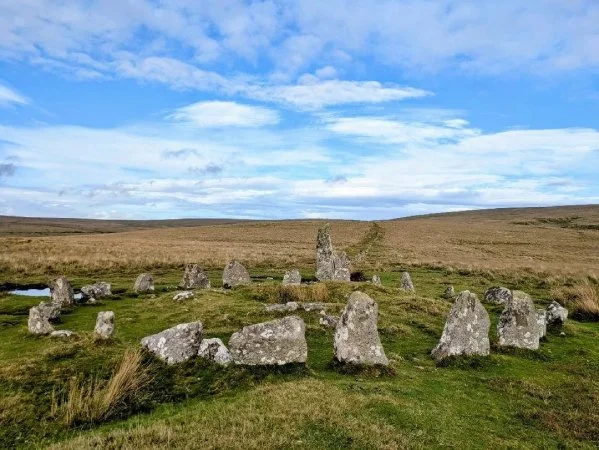
Down Tor stone circle, Dartmoor, South Devon
The prehistoric monuments of Dartmoor take many forms, each with its own character, energy and purpose.
Stone Circles
Stone circles are among the most powerful and recognisable of the sacred site forms. Ranging from intimate gatherings of a handful of stones to great sweeping rings and ceremonial complexes visible from miles around, they were built as places of ceremony, healing, and community gathering. Many are aligned with the movements of the sun, moon and stars, reflecting a sophisticated understanding of the cosmos and its relationship with life on earth. Stepping inside a stone circle is stepping into a contained field of energy, a space set apart from ordinary time, where the boundary between the everyday world and the wider dimensions of existence becomes thin.
Stone Rows and Avenues
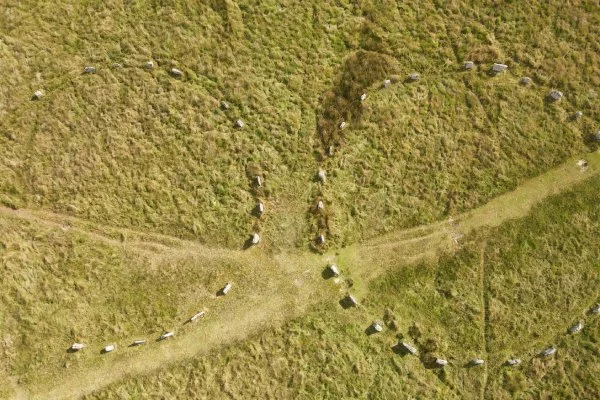
Stone Rows and Avenues are one of Dartmoor's most distinctive and remarkable features. Dartmoor has the highest concentration of stone rows in Britain, ranging from short double rows to the Erme Stone Row, the longest prehistoric stone row on earth, stretching for over two miles across the open moor. These rows were processional pathways, walked with intention as a way of moving between states of consciousness, attuning to the energetics of the land, or preparing for ceremony. The act of walking the row was itself the ritual, each step deepening the walker's connection with the landscape and with what lay ahead.
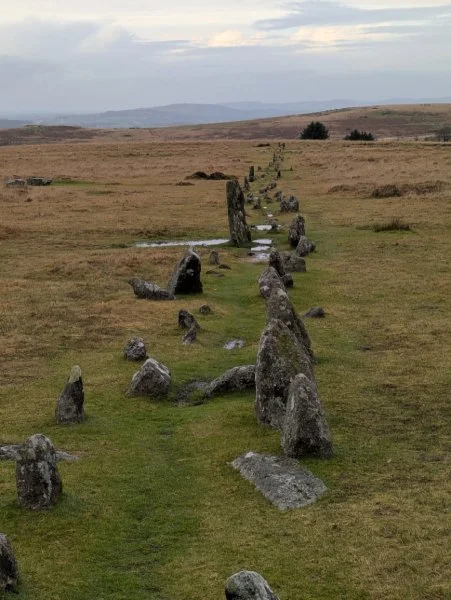
Merrivale stone row, Dartmoor, South Devon
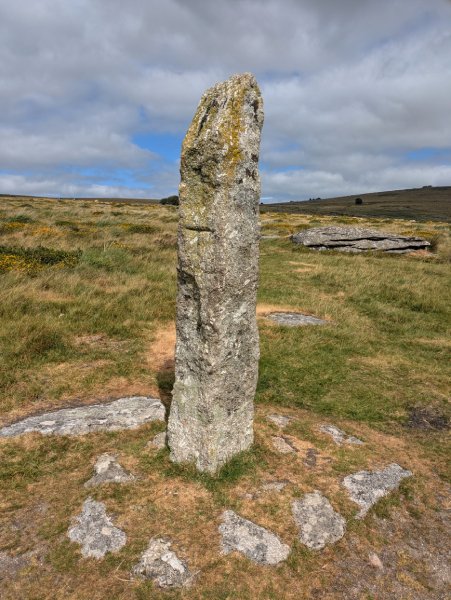
Shoveldown standing stone, Dartmoor, South Devon
Standing Stones
Standing Stones mark significant points in the landscape, often at the junction of energy lines or at the entrance to ceremonial complexes. They act as transmitters and receivers of earth energy, and many hold a distinct and powerful presence that can be felt by standing near or touching the megaliths.
Burial Cists and Cairns
Burial Cists and Cairns are the resting places of the ancestors, stone-lined graves originally covered by mounds of earth or rock, scattered across the moor in significant numbers, with around 180 known burial cists and cairns recorded on Dartmoor alone. They remind us that our ancestors understood death not as an ending but as a transition, and that the boundary between the living and the dead was something to be tended and honoured rather than feared.
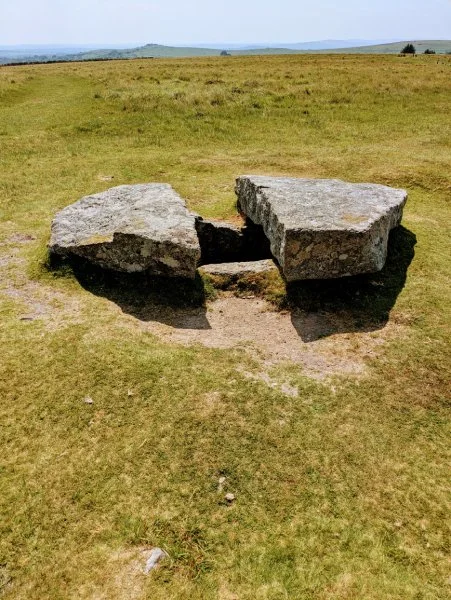
Merrivale splitstone, Dartmoor, South Devon
The Energetics of Sacred Sites
Each sacred site holds its own distinct energetic signature, its own quality of presence and purpose. Just as the Chinese system of meridians on the human body carry different qualities of energy to different organs and systems, the energy lines of the landscape carry different frequencies to different points across the earth. The sites that were built upon these points were chosen because of the particular quality of energy already present there, and the stones themselves were placed to amplify, focus and hold that energy in place.
Some sites carry a quality of deep healing, drawing in those who are unwell in body, mind or spirit and supporting a process of restoration and rebalancing. Others hold the energy of letting go, of release and transformation, making them powerful places to bring grief, anger, or anything that has been carried too long and needs to be surrendered. Some sites are places of vision and clarity, where the veils between worlds are thin and insight comes easily. Others carry a more grounding, stabilising energy, connecting us to the deep roots of the earth and helping us find our feet again.
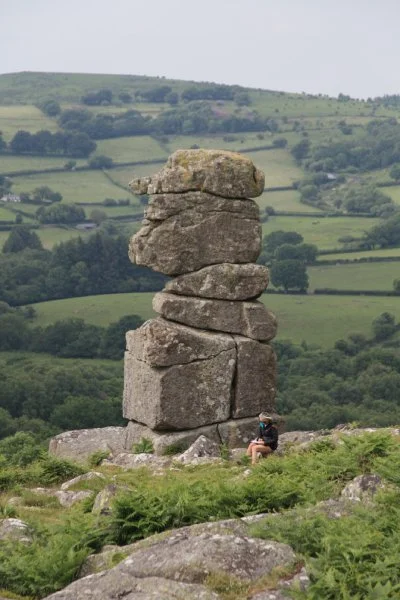
Bowermans Nose, Dartmoor, South Devon
A Living Network
The sacred sites of Dartmoor are part of a living network, connected by the energy lines that run across the landscape, each one influencing and being influenced by the others. When we gather at one site with intention, we are not only working with the energy of that particular place but contributing to the health and flow of the wider network of the Earth.
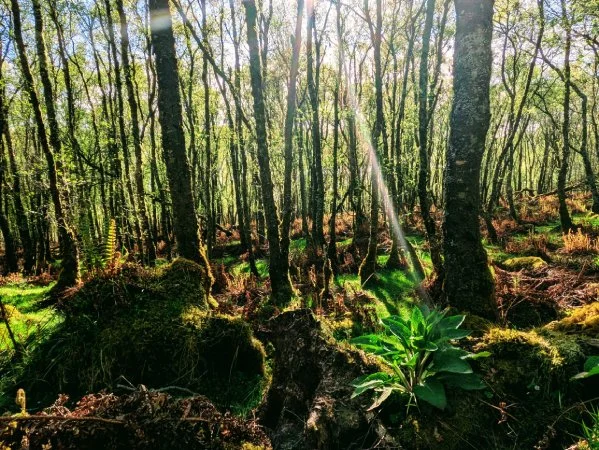
Forest on Isle of Bute, Hebrides, Scotland
This is why ceremony at sacred sites is still so important. It is not simply a personal or spiritual practice, though it is deeply both of those things. It is an act of reciprocity with the land, a way of tending the energetic health of the earth in the same way that our ancestors did for thousands of years. Our ancestors understood that the earth is not an inert backdrop to human life but a living, conscious presence, and they built at these points, gathered at them, and tended them across millennia, leaving them for us as an inheritance and an invitation to remember. When that tending stopped, when the ceremonies ceased and the sites were forgotten, a thread of connection was lost. Part of the work of returning to these places is restoring that relationship, picking up the threads of a practice that was interrupted and carrying it forward into our own time.
Explore Sacred Site Events
28th August - 4th September 2026
Channelled findings at Dartmoor's Sacred Sites
20th September 2026
Autumn Equinox Gathering at Grey Wethers Double Stone Circle, Dartmoor